copywriting 101 | Goop: The Thursday Newsletter
Every Wednesday I write about $uccessful brand voices and dissect their styles, their strengths, and single out the elements that you can steal to make your brand’s voice better - and sell more in the process. Are there any brand voices you’d like to read about in this blog? Email me.
I know what you’re thinking: when the founder and CEO is Gwyneth Paltrow, one of the queens of aspirational lifestyle brands, copywriting is the last thing your marketing team has to worry about. Most Goop subscribers probably hear every word in Paltrow’s voice inside their minds anyway. They all know her and probably love her, right?
Even if the majority of their subscribers/clients look up to her, it’s also safe to assume that there’s a segment of their audience that is still on the fence about whether or not to buy their products or follow their advice. Goop, after all, is not just Paltrow. As cute as it would be to think that she’s the only one coming up with ideas, writing drafts of their newsletter, or reviewing monthly metrics. The truth is that Goop operations and marketing are not a rom-com. This is why they’re currently valued at almost $450 million.
While you can see examples of Goop’s brand voice throughout their website and all of their email campaigns, their Thursday newsletters are a class in branding voice for anyone in the lifestyle and luxury spaces.
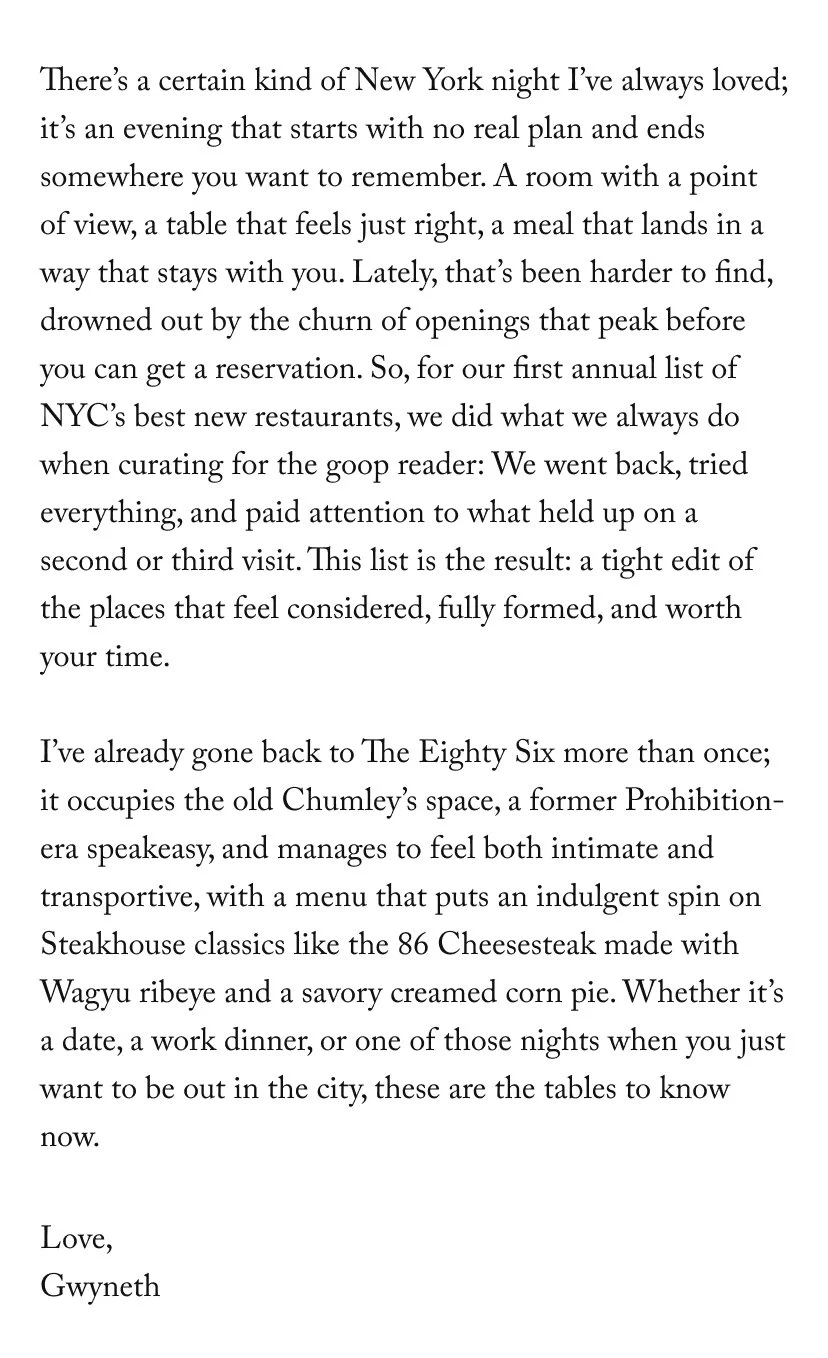
Smart, contained use of the first-person.
The only times that the newsletter begins with “I” are when the topic is vulnerable and emotional. Most of their Thursday newsletters don’t begin with “I” because it would become too self-centered and ultimately boring.
Concise warmth.
These are not lengthy personal essays. The word count is strict: between 300 and 600 words per email, including quotes and product blurbs.
The anecdotal approach is a classic for a good reason: it’s been tried and tested for centuries, and it always pulls readers in. Even if one glances through it fast, it’s still possible to capture the overall idea and narrative.
The story never gets in the way of the pitch: it supports it.
Casual polish.
The vocabulary is simple, achieving a neutrality that welcomes any reader. It doesn’t dumb down to make itself easier to understand, and it doesn’t adopt trendy expressions to sound “in”.
There is no intent to please or court the reader into liking Paltrow’s voice, or buying anything from her.
It’s similar to briefly running into an acquaintance who shares her latest discoveries and their most recent experiences with you, for your enjoyment and benefit. Before you have the chance to feel bored or tempted to say goodbye first, she beats you to it and leaves you wanting more.

Signature wrap-up.
One of the aspects I love the most about Goop’s Thursday newsletters is how they close every issue: a non-professional photograph followed by a simple and sophisticated list of headers (who, what, where, the details, field notes) that provide further details about the object, location, product, or individual showcased in the photograph. “Insider” tips, minus the condescension.
Even though Goop has a great blog that is updated frequently, these weekly newsletters are something different. They create a bond between the audience and Paltrow because the experience is akin to receiving a text from a dear friend or a close relative. The Thursday newsletters don’t compete with the blog, and they don’t feel pushy because even though their goal is the same as the rest of their email campaigns, the pitch is very well placed beneath the layers of emotional vulnerability, useful recommendations, and personal insights that make the readers feel like they’re part of Paltrow’s extended circle.
If you have been on the fence about a blog on your website, a weekly or biweekly newsletter might be the power move your brand is missing, particularly if you are in the lifestyle, self-care, or luxury spaces.
See you at the next one.